I Want
How a childhood lesson on manners shaped decades of silence and what it means to want, clearly and unapologetically.

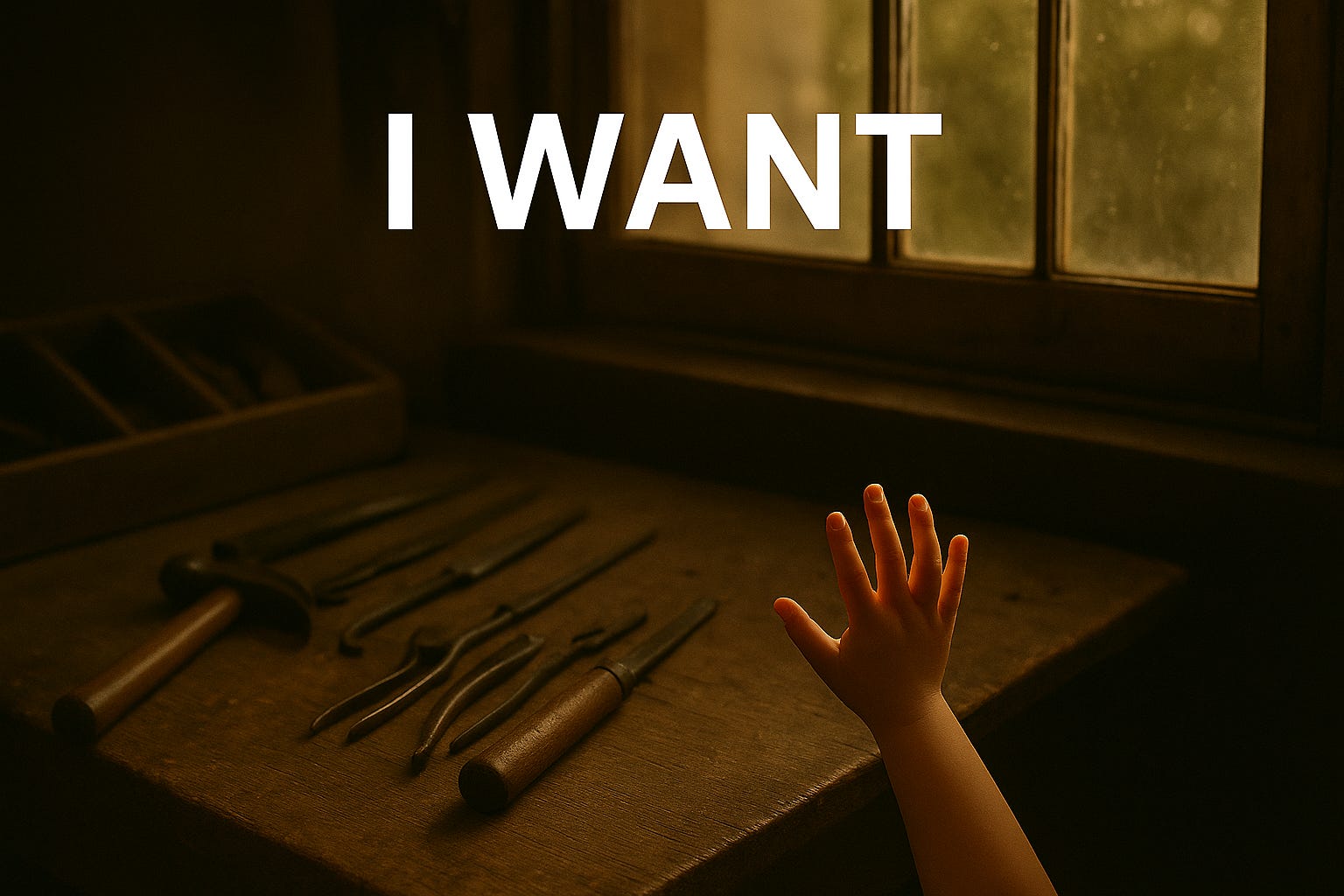
I want.
Two small words. So simple. So powerful. And for me, so foreign.
The other day, I sent a message to a friend with a request. At least, I thought it was a request. It went unanswered. When I followed up, they said, “There wasn’t a clear ask in your message.”
I was stunned.
What do I want?
It sounds like such a basic question, but I realized I had no idea how to answer it. For decades, I’ve spoken in euphemisms, trained in the fine art of suggestion rather than assertion. And it all started with ice cream.
I was four years old, playing in my grandfather’s workshop in the South of France. I adored that space - the scent of sawdust, the metallic clinks of tools, the quiet focus of my grandfather building something with his hands, red sharpened pencil behind his ear. I would “work” beside him, engraving zinc sheets with the smallest hammer he would entrust me with and his precious punch set, while he repaired or constructed something real.
At 4pm, French goûter time, I marched up proudly and said, “I want ice cream, please.”
I was so proud. I had not forgotten the magic word, so I was guaranteed to get the reward.
Yet he stopped what he was doing, held his fist at his waist, and chastised me, “We don’t say ‘I want,’ young lady,” he said firmly. “Not even the Queen of England says it. She says, ‘We want’- plural of majesty. You must ask politely: say ‘I would like,’ ‘It would please me to have,’ ‘Could I please have…’”. So the magic word was not enough.
From that moment, I want vanished from my vocabulary.
And so, three weeks ago, when someone told me they didn’t know what I wanted, I realized I didn’t know how to phrase it differently. Not because I don’t have desires, but because I’ve spent a lifetime disguising them.
Even today, when Grammarly suggests replacing “I would like” with “I want,” I instinctively reject it. It feels too direct. Too rude. Too… demanding.
But is it?
Is it really so outrageous to own our needs and desires out loud? And can you do it without sounding like a petulant four-year-old?
It turns out, there’s science behind why “I want” is so powerful. Neuroscience and communication research show that direct language isn’t just more assertive, it’s more effective. When we use clear, declarative statements like “I want,” the brain processes them more quickly and confidently. Our prefrontal cortex, which governs decision-making and reasoning, responds better to intention-driven language. In contrast, polite conditionals like “I would like” or “It would be nice if” force the brain to work harder to decode meaning, adding friction, softening the message, and weakening its impact.
So it’s not just personal. It’s neurological. Directness sharpens comprehension, while euphemism blurs it.
"Clarity isn’t rude. It’s neurologically efficient."
Of course, some of this is cultural. The French pride themselves on diplomacy, elegance, subtlety. But does that nuance come at the expense of clarity? Of being heard? Of getting what we need?
I’m still untangling this and figuring out when to choose directness over diplomacy and how to do so with intention.
I want to be kind. I want to be respectful. But I also want to be honest with others, and with myself. I want to speak in clear terms for others to get the message. And I want to be okay with wanting.
It’s not easy. Decades of programming don’t vanish with a single revelation. But maybe, just maybe, it starts with a deep breath and a sentence.
I want.